EN
EN  ID
ID  AR
AR  ZH
ZH 
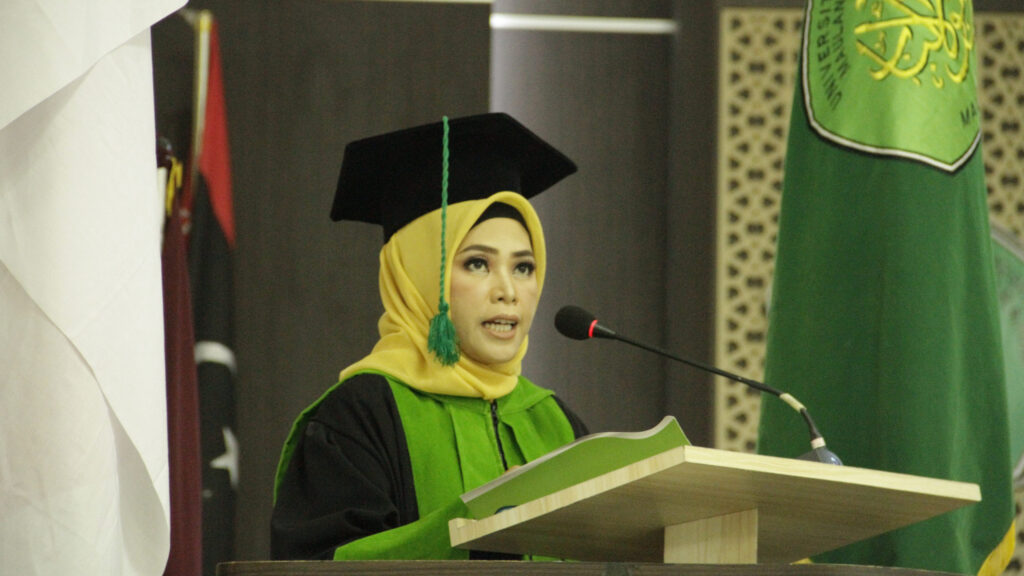
Wednesday (17/02/2021) was a historic day for UIN Maulana Malik Ibrahim Malang, especially the Faculty of Medicine and Pharmacy UIN Malang and the Undergraduate Pharmacy Study Program. On that day, the Faculty of Medicine and Pharmacy UIN Malang successfully produced a Professor in the Field of Pharmaceutical Biology, namely Prof. Dr. apt. Roihatul Mutiah, SF, M.Kes. who was officially inaugurated at the Inauguration Session of Professors at UIN Maulana Malik Ibrahim Malang. Also inaugurated at the ceremony were Prof. Dr. Roibin, M.HI from the Faculty of Sharia as Professor of Islamic Studies (Islamic Studies), and Prof. Dr. Nur Asnawi, M.Ag from the Faculty of Economics as Professor of Islamic Economics. An extraordinary achievement was made by Prof. Roiha, that he was able to obtain the highest functional position in the Higher Education environment at the age of only 41 years. This also makes him the youngest Professor at UIN Maulana Malik Ibrahim Malang.
In the Inauguration of UIN Malang Professors this time, as is tradition, before the new Professor delivers a scientific speech (oration), a curriculum vitae is first read. On this occasion, Prof. Dr. dr. Yuyun Yueniwati PW, M.Kes, Sp.Rad(K) who acted as the reader of Prof. Roiha's curriculum vitae said, "With the increase in the number of Professors, it is hoped that it will also increase the growth of knowledge and morals of the entire UIN Malang academic community.".

Atmosphere of the Open Senate Session for the Inauguration of Professors at UIN Maulana Malik Ibrahim Malang, Wednesday (17/02/2021) 
Reading of the biography of Prof. Dr. apt. Roihatul Mutiah, SF., M.Kes. by Prof. Dr. dr. Yuyun Yueniwati PW, M.Kes, Sp.Rad(K) 
The atmosphere at Campus I UIN Malang during the Inauguration of Professors 
Prof. Dr. apt. Roihatul Mutiah, SF, M.Kes. The youngest professor at UIN Malang
As someone who diligently studies the field of pharmaceutical biology, in her scientific oration Prof. Roiha raised the topic entitled "The Role of Phytopharmaceutics in Cancer Prevention and Therapy: Opportunities, Challenges, and Strategies." Phytopharmaceutics as regulated in the Regulation of the Minister of Health of Indonesia Number 760/MENKES/PER/IX/1992 are traditional medicinal preparations whose safety and efficacy have been proven. The raw materials of phytopharmaceuticals themselves can consist of simplicia or galenic preparations that have met the applicable requirements. By the end of 2020, there were only 25 products registered with the Food and Drug Monitoring Agency (BPOM) as phytopharmaceutical preparations. This concerned her, where the process for a herbal product to become a phytopharmaceutical is very long because the requirements must meet the aspects of efficacy and safety through clinical trials on humans. "The high cost of clinical trials and the lack of concern "The government and the public, including medical personnel, regarding the use of phytopharmaceutical preparations often become obstacles for the pharmaceutical industry to produce phytopharmaceuticals," said Prof. Roiha. According to Prof. Roiha, phytopharmaceutical preparations promise pharmacological therapy with minimal side effects, especially as a substitute for non-selective chemotherapy agents. He hopes that with various studies that have been developed, especially by the Faculty of Medicine, UIN Malang, regarding potential bioactive compounds as anticancer compounds contained in a number of endemic plants in Indonesia, they can become an alternative treatment for cancer in the future.
During his career at the Faculty of Pharmacy, UIN Malang, Prof. Roiha actively conducted research on the anticancer activity of a number of medicinal plants, including Widuri (Calotropis gigantea), mistletoe (Macrosolen cochinensis), Chrysanthemum (Chrysanthemum cinerarifolium), Sambiloto (Andrographis paniculata), yellow wood (Arcangelisia Flava (L.) Merr.), Dayak onion (Eleutherine palmifoliaAccording to him, there is not much research evidence on the above plants, especially to support the development of Indonesian herbal medicine towards the phytopharmaceutical level.
(Alif FF – Public Relations Team of FKIK UIN Malang)