EN
EN  ID
ID  AR
AR  ZH
ZH 

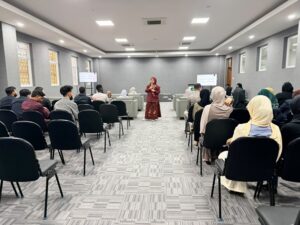
The second session of the Hajj Medicine seminar at the Faculty of Medicine and Health Sciences, UIN Malang, was filled by Dr. M. Zainul Mukhorobin, MMRS (Head of UKLW) of the Surabaya Class I Port Health Office, and Dr. H. Abdurachman, M.Kes, Head of the Malang Regency Health Office.
The organization of the Hajj pilgrimage, as mandated by Law No. 13 of 2008, aims to provide the best possible guidance, service, and protection for pilgrims so they can perform their pilgrimage in accordance with Islamic teachings. Organizing the Hajj pilgrimage involves preparation in Indonesia and implementation in the Holy Land, thus always facing various complex issues. Handling these complex issues is a crucial factor influencing the success of the Hajj.
“…Performing the Hajj is a human obligation towards Allah, namely (for) those who are able (to do it).istitha'ah) undertake the journey to the House of Allah.” (QS. Ali Imran [3]: 97). This verse states that the Hajj pilgrimage is only obligatory for those who are able to undertake the journey for the Hajj, which is commonly called istitha'ah. In order for health preparation efforts before departure to be well-coordinated and directed, it is necessary to establish clinical limits/criteria as a basis for determining whether a pilgrim is considered capable (Istitha'ah) in health aspects.
According to Dr. Abdurachman, health checks are continuous and comprehensive, implementing standardized health checks, treatment, and maintenance for Hajj pilgrims to ensure they can perform their pilgrimage optimally. Pre-departure health checks serve as a predictor of the risk of illness and death, including the First and Second Health Checks.
The First Stage Health Examination is a health examination for all Hajj pilgrims at the Community Health Center to obtain health data for care and maintenance efforts, as well as guidance and protection. The Second Stage Health Examination is an examination conducted to obtain the latest health status data for monitoring and evaluation of care, maintenance, guidance and protection efforts, as well as recommendations for determining the status of eligibility for Hajj departure. For Non-RISTI Hajj pilgrims, health data can be obtained from examinations for health care and maintenance conducted by the Health Examination Team of the Community Health Center, the Hospital Health Examination Team, the District/City Health Office, and the Provincial Health Office no later than two weeks before the Hajj embarkation operations begin, said Dr. Abdurachman.
The two stages of the Hajj health examination above are then used as a tool to determine the health eligibility of Hajj pilgrims. Determination of Health Eligibility is an effort to determine the health eligibility of Hajj pilgrims to undertake the Hajj pilgrimage, taking into account the results of the First and Second Stage Health Examination. The final examination results are then adjusted to meet the health requirements for Hajj, including airworthiness. Determination of the eligibility of Hajj pilgrims to depart for the Hajj is the authority of the port doctor at embarkation.
According to Dr. M. Zainul, the Port Health Office (KKP) has the task of preventing the entry and exit of diseases, potential epidemic diseases, epidemiological surveillance, quarantine, controlling environmental health impacts, health services, OMKABA supervision and security against new and re-emerging diseases, bioterrorism, biological elements, chemicals and radiation security in the working areas of airports, ports and land border crossings.
If a Hajj pilgrim is suspected of exhibiting symptoms similar to a dangerous infectious disease, the Port Health Office (KKP) will quarantine them for further treatment. In this regard, the Port Health Office (KKP) plays a crucial role in providing up-to-date information regarding the pilgrim.
Additionally, a person's eligibility to travel to Saudi Arabia requires having received meningitis and influenza vaccinations. Hajj pilgrims typically receive their vaccinations from a doctor's office or the Port Health Office (KKP). Upon receiving their vaccination, pilgrims provide their complete address, ensuring the KKP has the necessary data and information for the Community Health Center (Puskesmas) to monitor their health.